Заголовок: 3,5 миллиона параметров и 7 независимых локалей: как мы запустили авиапоисковик без рекламного бюджета
В нише авиабилетов, где правят бал гиганты вроде Aviasales и Skyscanner, кажется, что пробиться без бюджета в несколько миллионов долларов невозможно. Но в 2026 году правила игры изменились. Нейросети перевернули воронку привлечения трафика, и теперь побеждает не тот, у кого больше денег, а тот, у кого лучше архитектура данных.
Я архитектор проекта Cityvator — поисковика авиабилетов, который вышел из экосистемы Putivator. И сегодня я хочу показать «кухню» изнутри: как выглядит продукт, которому всего две недели, но он уже генерирует органический трафик и окупает себя без единого рубля на маркетинг.
Сухие цифры вместо обещаний
В маркетинге принято хвастаться «миллионами показов». Но давайте посмотрим на реальную статистику Google Analytics за первую неделю работы Cityvator:
- Отказы: 17,93%. В туристической нише нормой считаются 40–60%. Это значит, что пользователь заходит, видит понятный интерфейс и начинает искать билеты, а не закрывает вкладку.
- Глубина просмотра: 2,31. Люди не просто «пробегают» глазами, они изучают маршруты.
- Рост трафика +25,8% за неделю (без единой рекламной кампании).
- Проект уже вышел на самоокупаемость.
Почему это работает? Масштаб базы данных
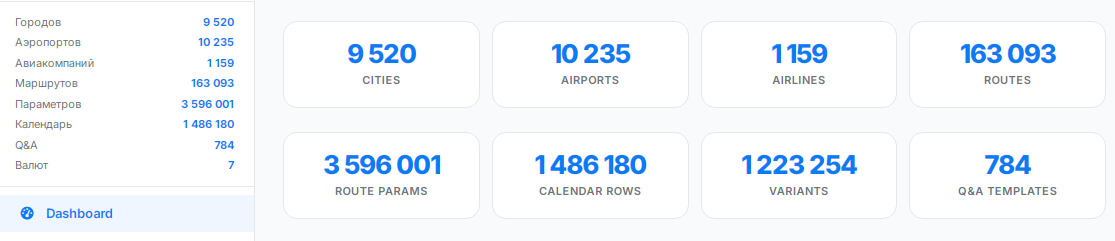
Секрет не в дизайне. Секрет в архитектуре. Посмотрите на панель управления Cityvator. В основе лежит не просто база рейсов, а математическая модель авиасообщений:
- 9 520 городов
- 10 235 аэропортов
- 1 159 авиакомпаний
- 163 093 маршрута
- 3 588 390 параметров (и это число постоянно растет в фоновом режиме).
- 1 483 161 строка календарей цен.
Мы не берем данные из воздуха. Мы структурируем миллионы параметров каждого рейса. Именно на такой структуре ИИ-агенты (ChatGPT, DeepSeek и другие) учатся отвечать на вопросы пользователей о полетах.
7 независимых локалей: не перевод, а разные рынки
Отдельная гордость проекта — это наш подход к локализации. У Cityvator 7 полноценных, независимых друг от друга локалей в одной базе: EN, DE, FR, IT, ES, PT и AR. Это не просто перевод интерфейса. Это семь разных сущностей, заточенных под менталитет, валюту и особенности авиасообщения конкретных стран.
Посмотрите на скрин статистики. Мы только запустились, но уже видим реальный отклик: Германия, Китай, США, Испания, Турция. Каждая локаль генерирует собственных пользователей, потому что мы изначально проектировали систему не как «русский сайт с кнопкой перевода», а как глобальную платформу.С
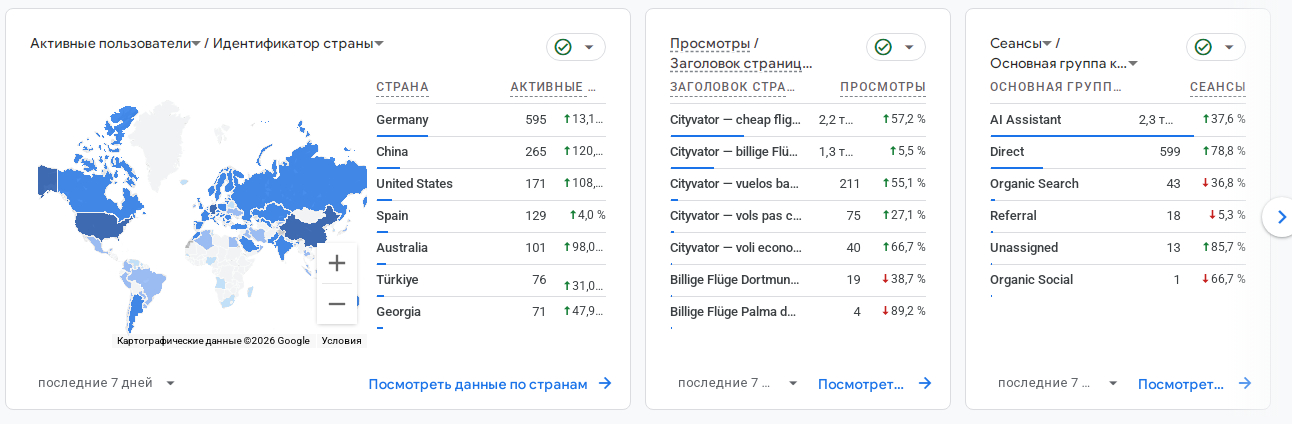
Причем, обратите внимание на источники трафика: AI Assistant — 2,3 тыс. сессий (+37,6%). Это нейросети уже приводят к нам людей на разных языках.
ИИ как новый канал трафика
Пока одни компании платят за клики, мы сделали так, чтобы ИИ сам приводил нам пользователей.Когда мы создавали Cityvator, то общались с нейросетями (ChatGPT, DeepSeek, Flexibl) как с коллегами. Они подсказывали, как сделать API удобнее для парсинга, и указывали на узкие места в структуре.
Это привело к неожиданному эффекту. Система стала настолько понятной для машинного чтения, что трафик от ИИ-ботов в Putivator доходил до 1 млн запросов в день. В пиковые моменты нагрузка была такой, что хостер-провайдер приостанавливал работу, чтобы мы не положили сервера.
Именно поэтому сейчас в Cityvator мы сразу заложили защиту (rate limiting), чтобы система работала стабильно. ИИ-агенты с удовольствием индексируют наши данные, а мы получаем бесплатный трафик из Сингапура, Гонконга и Китая.
Вывод для рынка
В 2026 году перестали работать старые схемы. Вы не можете просто «купить» внимание. Вы должны сделать так, чтобы ваш продукт был удобен и людям, и машинам.
Cityvator — это пример того, как архитектор без инвестиций и бюджета на рекламу может создать продукт, который с первых дней работы показывает метрики уровня топовых агрегаторов. Главное — не тратить деньги на маркетинг, а вкладывать их в архитектуру данных.
Кирилл Захаренко, основатель и архитектор Putivator и Cityvator
Title: 3.5 Million Parameters and 7 Independent Locales: How We Launched a Flight Search Engine with Zero Ad Budget
In the flight booking niche, dominated by giants like Aviasales and Skyscanner, it seems impossible to break through without a multi-million dollar budget. But in 2026, the rules have changed. Neural networks have flipped the traffic acquisition funnel, and now the winner is not the one with the biggest wallet, but the one with the best data architecture.
I am the architect of Cityvator, a flight search engine that emerged from the Putivator ecosystem. Today I want to show you the "kitchen" from the inside: what a product looks like when it is just two weeks old, yet already generates organic traffic and pays for itself without a single ruble spent on marketing.
Hard Numbers Instead of Promises
In marketing, it is customary to brag about "millions of impressions." But let's look at the real Google Analytics data for the first week of Cityvator's operation:
- Bounce rate: 17.93%. In the travel niche, the norm is 40–60%. This means users land, see a clear interface, and start searching for flights instead of closing the tab.
- Page depth: 2.31. People do not just skim; they study the routes.
- Traffic growth +25.8% per week (without a single ad campaign).
- The project has already reached break-even.
Why Does It Work? The Scale of the Database
The secret is not in the design. The secret is in the architecture.Take a look at the Cityvator admin panel. At its core lies not just a flight database, but a mathematical model of air travel:
- 9,520 cities
- 10,235 airports
- 1,159 airlines
- 163,093 routes
- 3,588,390 parameters (and this number keeps growing in the background).
- 1,483,161 rows of price calendars.
We do not pull data out of thin air. We structure millions of parameters for every flight. It is on this kind of structure that AI agents (ChatGPT, DeepSeek, and others) learn to answer users' questions about flights.
7 Independent Locales: Not a Translation, but Different Markets
A separate source of pride for the project is our approach to localization. Cityvator has 7 fully independent locales within a single database: EN, DE, FR, IT, ES, PT, and AR. This is not just an interface translation. These are seven distinct entities tailored to the mentality, currency, and air travel specifics of each country.
Look at the statistics screenshot. We have just launched, yet we already see real engagement: Germany, China, the USA, Spain, Turkey. Each locale generates its own users because we designed the system from the start not as a "Russian site with a translation button," but as a global platform.
Moreover, pay attention to the traffic sources: AI Assistant — 2,300 sessions (+37.6%). Neural networks are already bringing us people in different languages.
AI as a New Traffic Channel
While others pay for clicks, we have engineered it so that AI brings us users on its own.When we were building Cityvator, we communicated with neural networks (ChatGPT, DeepSeek, Flexibl) as colleagues. They suggested how to make the API more parser-friendly and pointed out bottlenecks in the structure.
This led to an unexpected effect. The system became so machine-readable that AI bot traffic on Putivator reached 1 million requests per day. At peak times, the load was so intense that our hosting provider paused operations to prevent us from crashing the servers.
That is why we built protection (rate limiting) into Cityvator from the start, ensuring stable operation. AI agents eagerly index our data, and we get free traffic from Singapore, Hong Kong, and China.
The Takeaway for the Market
The old schemes stopped working in 2026. You cannot simply "buy" attention. You must make your product convenient for both humans and machines.
Cityvator is an example of how an architect without investments or an ad budget can create a product that shows top-tier aggregator metrics from its first days. The key is not to spend money on marketing, but to invest it in data architecture.