How to Rent a Car Abroad: A Smart Guide for International Road Trips
Renting a car in another country can make a holiday far more flexible. You can leave the airport on your own schedule, stop in smaller towns, visit places beyond the main tourist routes, and avoid planning every journey around public transport.
The process is not always as simple as choosing the cheapest car on a booking page. Rental rules differ between countries, companies, airports, and vehicle categories. A supplier may require a credit card, place a temporary hold on your funds, limit cross-border travel, or apply a different insurance excess to each tariff.

A little preparation before booking can help you choose a suitable vehicle, understand your financial responsibility, and avoid problems at the collection desk.
Decide Whether You Really Need a Rental Car
A car is not always the best choice for an international trip. In many European cities, trains and public transport are faster and easier than driving. Parking may be expensive, historic centres may have traffic restrictions, and local roads can be difficult for unfamiliar drivers.
A rental car is usually more useful if you plan to:
- Visit several towns or regions
- Stay in a rural area
- Travel along the coast
- Explore national parks or mountain areas
- Carry sports equipment or several suitcases
- Travel with young children
- Reach beaches, villages, or attractions away from bus routes
- Continue to another country during the same trip
For a city break, you may save time and money by collecting a car only after your city sightseeing is finished. This can be more practical in destinations such as Rome, Milan, Barcelona, Lisbon, Athens, or Dubrovnik.
Before booking, map out your route and identify where you will park. The right rental period may be shorter than the length of your holiday.
Compare Rental Offers Beyond the Daily Rate
The daily price is only one part of the total cost. Two similar vehicles can have very different conditions, so compare the full offer before choosing.
Look at:
- Total rental price
- Deposit or card hold
- Insurance excess
- Fuel policy
- Mileage allowance
- Payment requirements
- Pickup and return location
- Cancellation rules
- Additional driver charges
- Airport or station fees
- Border-crossing conditions
- Late collection and return fees
- Vehicle size and luggage capacity
A rental comparison platform such as RCForYou can help travellers review available cars across different destinations. Enter the location and travel dates, compare vehicle categories, and open the conditions for each offer before making a booking.
A comparison service saves time, but it does not remove the need to read the supplier’s terms. The exact rules apply to the selected vehicle and tariff, not to every car shown on the platform.
Understand the Rental Deposit
The deposit is one of the most important details in an international rental agreement. It may be called a security deposit, pre-authorisation, card hold, or refundable deposit.
A supplier may hold funds to cover possible charges such as:
- Damage to the vehicle
- Missing fuel
- Traffic fines
- Toll fees
- Late return
- Cleaning
- Lost keys
- Unauthorised use
- Contract violations
In many cases, the deposit is not a final charge. The supplier places a temporary hold on the card, which reduces the amount available to spend. The release time depends on the rental company and the card issuer.
Before booking, check:
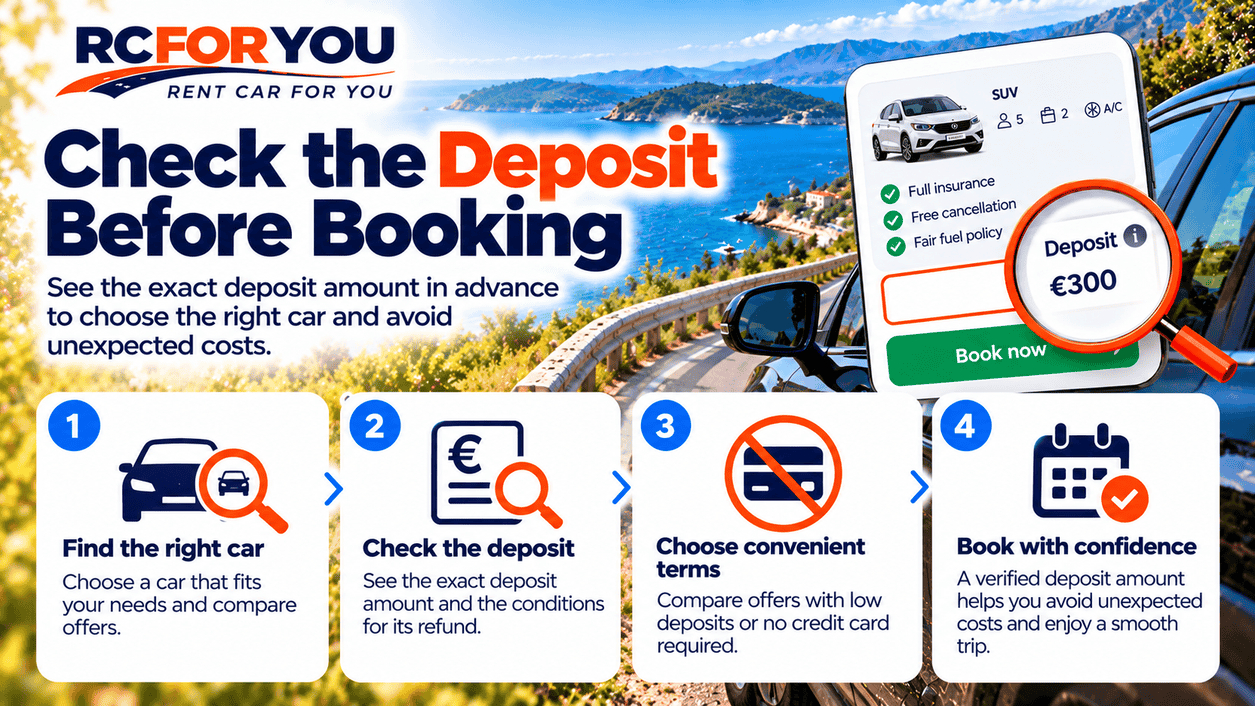
- The exact deposit amount
- Whether the funds are blocked or charged
- Which card types are accepted
- Whether the main driver must own the card
- How long the release may take
- Whether a different tariff has a lower deposit
- Whether an alternative payment method is allowed
An offer described as “no deposit” does not always mean that the renter has no financial responsibility. You may still be charged for items excluded from the insurance policy, fuel differences, fines, tolls, lost keys, or damage caused by breaking the rental rules.
Check the Insurance Excess Carefully
Basic insurance is often included in the rental price, but it may come with an excess. The excess is the amount the renter may have to pay after a covered incident.
The deposit and excess are different:
- The deposit is a financial guarantee for the rental agreement.
- The excess is the renter’s possible liability after damage or theft.
- Additional cover may reduce the excess.
- Certain parts of the vehicle may remain excluded.
Read the policy details and check whether protection applies to:
- Bodywork
- Windows and windscreen
- Tyres
- Wheels and rims
- Mirrors
- Roof
- Underside
- Interior
- Keys
- Incorrect fuel
- Towing
- Unauthorised drivers
A package described as full or comprehensive cover may still include exclusions. Look for the list of items not covered rather than relying on the name of the product.
Also check who provides the cover. Protection purchased from the rental company may follow a different claims process from separate insurance bought through another provider.
Confirm the Payment Method Before You Travel
Payment requirements can cause problems at the pickup desk. A supplier may accept one card for the booking but require another card for the deposit.
Read the payment conditions and check:
- Is a credit card required?
- Is a debit card accepted?
- Must the card be in the main driver’s name?
- Is a physical card required?
- Are virtual or prepaid cards allowed?
- Can the deposit be paid in cash?
- Is the card required to support a pre-authorisation?
- Is the balance paid online or at pickup?
- Are cards issued in another country accepted?
Some suppliers accept debit cards only for selected categories or tariffs. A premium vehicle may have stricter requirements than a small economy car.
Do not assume that a successful online payment proves that the same card will be accepted at collection. The booking payment and the security deposit may follow different rules.
If you have no credit card, search specifically for offers that mention debit-card acceptance, low deposit, or no card hold. Read the conditions for the individual vehicle and request written clarification if the wording is unclear.
Check the Documents and Driving Licence Rules
The required documents depend on your nationality, destination, licence type, and rental company. Common documents include:
- Passport or national identity document
- Valid driving licence
- Booking confirmation or voucher
- Payment card
- Proof of address, in some cases
- International Driving Permit, where required
- Written permission for cross-border travel, where applicable
Your driving licence usually needs to remain valid for the entire rental period. Some companies also require the driver to have held the licence for a minimum period.
An International Driving Permit may be needed if:
- Your licence is not written in the local language or Latin alphabet.
- The destination’s rules require one.
- The rental company lists it as mandatory.
- You plan to drive in more than one country.
- Your licence format is not easily understood by local authorities.
An International Driving Permit normally works alongside your national licence. It does not replace the original document.
Check the current requirements with an official government source or embassy, then compare them with the conditions shown by the rental supplier.
Choose a Car That Matches the Journey
The most suitable vehicle depends on the roads, passengers, luggage, parking, and length of the trip.
Small Cars for Urban Travel
A small hatchback is easy to handle in busy cities and narrow historic areas. It may also use less fuel and fit into smaller parking spaces.
Check the boot dimensions before booking. A vehicle with four seats may not have enough room for four large suitcases.
Compact Cars for Mixed Routes
A compact vehicle is a practical choice for a combination of city driving, motorways, and countryside roads. It offers more comfort than a small hatchback without becoming difficult to park.
Estates and Sedans for Longer Journeys
A sedan or estate car can offer extra legroom and luggage space. This can make a difference on a multi-day road trip, especially if the car will be occupied by several adults.
SUVs for Families and Extra Equipment
An SUV or crossover may suit families, groups, or travellers carrying bicycles and other equipment. However, a larger vehicle can be harder to use on narrow roads and in compact parking areas.
Do not select a large vehicle unless you need the space. A smaller car may be a better choice for old towns, mountain villages, and busy resorts.
Automatic or Manual
Choose a transmission you can drive confidently. Manual vehicles may be more common in some countries, while automatic cars can sell out quickly during busy periods.
Automatic transmission can be useful in traffic, on steep roads, and during long journeys in unfamiliar areas. If you normally drive an automatic, do not book a manual vehicle just to reduce the price.
Review Fuel and Mileage Conditions
Fuel policies can change the final cost of a rental. Common arrangements include:
- Full tank on collection and return
- Same fuel level at collection and return
- Pre-purchased fuel
- Fuel supplied at an additional service charge
A full-to-full policy is usually easy to understand. You collect the car with a full tank and return it with a full tank. Keep the receipt from the last fuel station and photograph the fuel gauge.
Check the mileage allowance too. Some tariffs include unlimited mileage, while others apply a daily or total limit. Extra kilometres may be charged when the car is returned.
Understand Airport Collection Procedures
Airport rental does not always mean that the vehicle is waiting beside the terminal. Collection may take place at:
- A desk inside the terminal
- A separate airport rental building
- An off-site office
- A nearby car park
- A location reached by shuttle bus
- A meeting point with a representative
Read the voucher for the exact instructions. Check the office hours, flight-delay procedure, shuttle details, and contact number.
Late arrival can cause problems if the office closes at a fixed time. Some suppliers offer after-hours collection for an additional fee, while others require advance notice.
Also check whether the quoted price includes airport charges. These may be listed separately from the base rental rate.
Check Cross-Border Travel Rules
A rental car cannot automatically be driven into every neighbouring country. Permission depends on the supplier, vehicle, insurance, and tariff.
If you plan to cross a border, check:
- Which countries are allowed
- Whether written approval is required
- Whether a cross-border fee applies
- Whether the insurance remains valid
- Whether additional documents are needed
- Whether ferry travel is permitted
- Whether the car can be returned abroad
- Whether certain vehicle categories are excluded
Do not rely on an informal conversation at the rental desk. Get permission in writing and keep it with your booking documents.
A route that crosses several borders may require separate approval for each country. Plan this before you pay for the reservation.
Inspect the Vehicle at Collection
A detailed inspection takes only a few minutes and creates a useful record of the car’s condition.
Before leaving:
- Confirm the registration number, fuel type, transmission, and vehicle category.
- Review the deposit, insurance excess, and return time.
- Inspect the bumpers, doors, mirrors, windows, wheels, tyres, roof, and visible underside.
- Check the interior for stains, scratches, and other damage.
- Compare the car with the handover report.
- Photograph and record a video of the vehicle from several angles.
- Photograph the fuel gauge and odometer.
- Test the lights, air conditioning, wipers, locks, and dashboard indicators.
- Save the supplier’s emergency and roadside-assistance numbers.
- Ask for any missing damage to be added to the handover document.
Repeat the process when returning the car. Take photos of the fuel level, mileage, exterior, and parking position. Request a signed return document or electronic confirmation.
Watch for Common Rental Mistakes
International travellers often run into trouble because they focus on the headline price and overlook the conditions.
Common mistakes include:
- Booking without checking the deposit
- Assuming a debit card will be accepted
- Choosing a car that cannot fit the luggage
- Ignoring the insurance excess
- Failing to check the pickup location
- Forgetting to add an additional driver
- Missing the fuel return requirement
- Driving through restricted city zones
- Crossing a border without approval
- Failing to record existing damage
- Returning the car outside the agreed time
- Leaving without a copy of the contract
A low price is useful only if the payment method, insurance, vehicle size, and rental rules match your needs.
A Simple Booking Process
Use this sequence when arranging an international rental:
1. Map the Trip
List the cities, airports, border crossings, and rural areas you plan to visit.
2. Choose the Rental Period
Decide whether you need the car for the entire holiday or only for the days outside the city.
3. Compare Vehicles
Look at luggage space, transmission, fuel type, passenger capacity, and vehicle size.
4. Read the Financial Conditions
Check the rental price, deposit, card hold, insurance excess, fuel policy, and possible extra charges.
5. Confirm the Documents
Check driving licence rules, age requirements, passport requirements, and International Driving Permit conditions.
6. Review the Supplier
Find out who provides the vehicle, where the office is located, and how pickup and return work.
7. Save the Paperwork
Keep the booking confirmation, insurance details, payment receipt, supplier contacts, and written approval for any border crossing.
Final Thoughts
A successful international car rental starts before you reach the airport. Compare offers by their full conditions, not only by the daily rate. Confirm the deposit, insurance excess, payment card, driving documents, mileage, fuel policy, and border rules.
Choose a car that fits the roads and the passengers, photograph it at collection, and keep the return confirmation. Platforms such as RCForYou can make the comparison stage easier by bringing rental options from different destinations together in one place.
With careful preparation, driving abroad becomes more predictable, flexible, and enjoyable.