Car Rental in Italy: How to Rent a Car Safely
A rental car can turn an Italian holiday into a real road trip. It gives you the freedom to leave the big cities, stop in small villages, explore vineyards, visit coastal towns, and travel at your own pace. From Tuscany’s hill roads to Sicily’s beaches, the lakes in the north, and quiet towns in Puglia, many of Italy’s best places are easier to reach by car.
Still, car rental in Italy needs careful planning. The advertised daily rate is only one part of the booking. Deposit rules, accepted cards, insurance excess, fuel policies, traffic restrictions, and airport collection procedures can all affect the final experience and cost.
This guide explains how to rent a car in Italy safely, choose the right vehicle, and look for rental options with no deposit or without a traditional credit card requirement.
Is It Worth Renting a Car in Italy?
It depends on your itinerary. Italy has fast trains between major cities, and public transport can be more convenient than driving in central Rome, Milan, Florence, Venice, or Naples. Historic centres often have narrow streets, limited parking, and restricted traffic zones.
A car is most useful once you leave the city.
Rent a car in Italy if you plan to:
- Explore Tuscany, Umbria, Puglia, Sicily, Sardinia, or the Italian lakes
- Visit small towns not easily reached by train
- Travel with children, luggage, beach equipment, or a large group
- Follow a flexible route instead of fixed train schedules
- Stay in countryside villas, agriturismos, or remote coastal areas
- Combine several regions during a longer holiday
For example, collecting a car after a few days in Rome can be more practical than driving through the capital from the first day. The same applies to Milan, where a vehicle is often better used for trips to Lake Como, Lake Garda, the Alps, or smaller towns in Lombardy.
Where to Pick Up a Rental Car in Italy
Italy airport car rental is popular because it allows travellers to collect a vehicle soon after landing and head directly to their accommodation or next destination.
Common pickup points include airports, city-centre offices, railway stations, and delivery locations. Airport collection is often convenient, but the process varies from one supplier to another.
Your pickup may involve:
- A rental desk inside the terminal
- A desk in a connected car rental building
- A vehicle collection point in an airport car park
- A shuttle bus to an off-airport office
- A meeting point with a company representative
Before travelling, read the booking voucher carefully. Check the exact pickup location, office hours, supplier telephone number, return procedure, and instructions if your flight is delayed.
Car Rental in Rome
Car rental Rome options are available at the city’s airports and in selected central locations. Rome is a good starting point for journeys through Lazio, Tuscany, Umbria, Amalfi Coast routes, and southern Italy.
Driving in the historic centre can be difficult due to traffic, parking restrictions, and ZTL zones. Many travellers find it easier to spend time in Rome without a car, then collect one at the airport or an office outside the centre before continuing their trip.
Car Rental in Pisa
Pisa is a convenient starting point for Tuscany and the Ligurian coast. A rental car can make it easier to visit Lucca, Siena, San Gimignano, Chianti, Volterra, coastal villages, and countryside accommodation.
Car rental Pisa may work particularly well for travellers who want to build a road trip around smaller Tuscan towns, where public transport connections are less direct.
Car Rental in Catania
Catania is one of the main gateways to eastern Sicily. A car gives visitors more freedom to explore Mount Etna, Taormina, Syracuse, Noto, Ragusa, beaches, and rural parts of the island.
Catania itself has busy traffic and limited parking in some areas, so plan ahead if your hotel is in the centre. For a Sicily road trip, though, a rental car is often one of the most practical ways to travel.
Car Rental in Milan
Car rental Milan is useful for travellers heading to Lake Como, Lake Garda, Verona, the Dolomites, Piedmont, or Switzerland. Milan has strong rail connections, so a car may not be needed for city sightseeing. It becomes valuable when you want to explore the north beyond the train network.
As in Rome, driving in central Milan can involve restricted zones and paid parking. Check your accommodation’s parking options before arrival.
What Does “Without a Deposit” Really Mean?
Many travellers search for car rental Italy without deposit because they do not want a large sum temporarily blocked on their card. This is understandable, but the phrase needs careful interpretation.
A no-deposit car rental Italy offer may be available in certain cases, but the conditions depend on the supplier, location, travel dates, vehicle category, payment method, and insurance package.
Security Deposit or Card Hold
A security deposit is a refundable amount that a rental company may hold or block on a payment card at pickup. It is intended to cover potential charges under the agreement, such as damage, missing fuel, late return, fines, or other costs.
The amount may be released after the car is returned, provided there are no extra charges. The timing can depend on the supplier and your bank or card issuer.
Low Deposit
A low-deposit offer means a smaller security hold may apply compared with a standard rental tariff. It does not always mean that no card block will be made.

Insurance Excess
The insurance excess is the maximum amount a renter may be responsible for if the vehicle is damaged or stolen under the policy terms. It is separate from the daily rental price and may not be identical to the deposit amount.
Full Coverage or Excess Reduction
Some rental options include additional cover that reduces the excess. This can lower the driver’s financial exposure, but you should still read the exclusions carefully.
Common exclusions may include:
- Tyres and wheels
- Windscreen or other glass damage
- Underbody or roof damage
- Lost keys
- Interior damage
- Incorrect fuel
- Damage caused by unauthorised drivers
- Driving on prohibited roads
- Damage caused by ignoring traffic rules or rental conditions
No deposit does not mean no financial responsibility. A renter can still be liable for damage outside the insurance cover, traffic fines, tolls, fuel differences, cleaning costs, contract violations, or prohibited use of the vehicle.
How to Find No-Deposit or No-Credit-Card Rental Options
If you want car hire Italy no deposit or need to rent a car in Italy without a credit card, compare each offer carefully instead of relying on the main price alone.
Follow these steps:
- Enter your exact pickup and return dates, times, and locations.
- Select the correct airport or city, such as Rome, Pisa, Catania, or Milan.
- Use available filters for “No Deposit,” “No Credit Card,” “Low Deposit,” or “Debit Card Accepted.”
- Open the full rental terms for each car you are considering.
- Check whether the supplier requires a physical payment card at pickup.
- Confirm that the card must be in the main driver’s name, if stated in the terms.
- Look for references to a security deposit, pre-authorisation, refundable hold, or card block.
- Review the insurance excess, fuel policy, mileage allowance, cancellation policy, and late-return rules.
- Ask for written clarification before booking if an important point is unclear.
Debit card car rental Italy may be possible with selected suppliers and tariffs. However, not every company accepts debit cards, prepaid cards, virtual cards, or cards belonging to another person. The fact that an online booking was paid by card does not automatically mean that the same card will be accepted when collecting the vehicle.
Choosing the Right Car for Your Trip
The best car is not necessarily the largest or the cheapest. Think about your route, number of passengers, luggage, parking plans, and confidence behind the wheel.
Small Cars
Small hatchbacks are often a smart choice for couples, solo travellers, and short road trips. They are easier to park, more comfortable on narrow roads, and often use less fuel.
They can be particularly useful in smaller towns, coastal areas, and places with tight streets. However, check the boot size if you are travelling with large suitcases.
Compact Cars and Sedans
Compact cars and sedans offer a useful balance between comfort, luggage capacity, and manoeuvrability. They work well for couples with more luggage or small families travelling between cities and countryside destinations.
SUVs and Larger Vehicles
An SUV or larger family car can be more comfortable for long distances, several passengers, or lots of luggage. They may suit road trips through rural or mountain areas, but remember that bigger vehicles can be harder to park in historic towns and busy coastal resorts.
Automatic or Manual Transmission
Manual cars are common in Italy. If you are comfortable driving a manual gearbox, you may find more choice. But if you have little experience with manual transmission, choose an automatic car.
This matters on hills, winding roads, city traffic, and unfamiliar routes. Book the transmission you can drive confidently, not simply the one with the lowest rate.
Documents, Age, and Payment Requirements
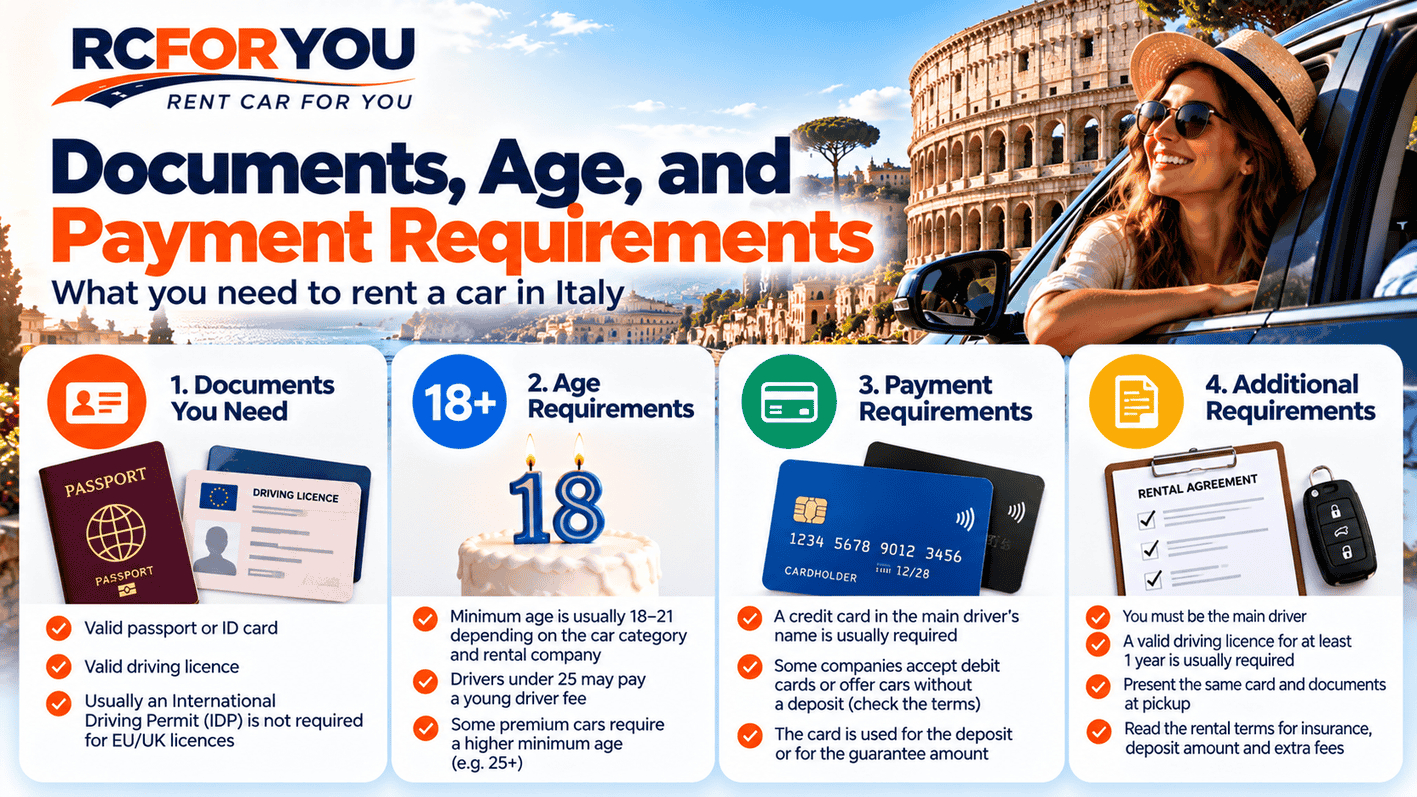
Rental requirements vary, but drivers commonly need:
- Passport or national ID
- Valid driving licence
- Booking voucher
- Accepted payment card or another approved payment method
- International Driving Permit, where required by the supplier, licence country, or licence language
The main driver usually needs to be present at collection and show the original documents. If another person will drive the car, they should be added to the agreement before departure.
Minimum age, driving-experience requirements, and young-driver charges differ by company and vehicle category. Larger, premium, or automatic vehicles may have stricter conditions.
Insurance and Extra Costs to Check
Before finalising your Italy car hire, read the conditions related to insurance and additional charges. The lowest daily rate can look attractive, but it may not include all the terms that matter for your trip.
Check:
- Basic insurance included in the rate
- Damage and theft excess
- Tyre, wheel, glass, interior, key, and underbody exclusions
- Fuel policy
- Mileage limit, if any
- Additional driver fee
- Child seat and equipment charges
- One-way rental fee
- Out-of-hours pickup or return fees
- Toll roads and fuel costs
- Parking charges
- Fine administration charges
A full-to-full fuel policy is often easy to understand. You collect the car with a full tank and return it full. Keep your final fuel receipt, especially if you fill up near the return location.
Safe Pickup and Return Checklist
Use this checklist when collecting and returning your rental car:
- Read the rental agreement before signing it.
- Confirm the deposit, card hold, insurance excess, and return time.
- Inspect the bodywork, wheels, tyres, glass, mirrors, interior, fuel level, and odometer.
- Take timestamped photos and a video of the vehicle before leaving.
- Ask for every existing scratch, dent, or mark to be recorded in the handover document.
- Check the lights, air conditioning, wipers, warning lights, and required equipment.
- Save the supplier’s contact number and roadside-assistance details.
- At return, take new photos of the car, fuel gauge, mileage, and parking position. Keep all signed documents and return confirmation.
Do not rush the inspection. A few minutes at pickup can prevent a difficult discussion later.
Driving in Italy: What Tourists Should Know
Italy drives on the right-hand side of the road. Main roads and motorways are generally well developed, but driving conditions can change quickly between cities, mountain routes, countryside lanes, and coastal roads.

Watch for ZTL Zones
One of the most important issues for visitors is the ZTL, or Zona a Traffico Limitato. These restricted traffic zones are common in historic city centres. Cameras may record unauthorised vehicles entering restricted areas.
Rome, Pisa, Catania, Milan, Florence, Bologna, and many smaller towns have traffic restrictions. Do not follow navigation instructions blindly into a historic centre. Check with your hotel about parking access and ZTL rules before arrival.
Plan Parking in Advance
Parking can be limited and expensive in cities and popular tourist areas. Look for official car parks, confirm whether your accommodation has parking, and pay attention to local signs, colours, permits, and time limits.
Allow Time for Tolls and Rural Roads
Many Italian motorways have tolls. Keep a payment card and other suitable payment method available if needed. Rural roads can be narrow, winding, and slower than they appear on a map, especially in hill towns and coastal areas.
Drive calmly, avoid rushing between destinations, and build extra time into your route.
Common Car Rental Mistakes to Avoid
Avoid these frequent problems:
- Choosing only the lowest advertised daily rate
- Assuming “without a deposit” means no excess or no liability
- Not checking whether a debit card is accepted
- Arriving without the required physical payment card
- Booking a car that is too small for people and luggage
- Selecting manual transmission without confidence
- Ignoring ZTL restrictions
- Failing to photograph existing damage
- Forgetting the fuel policy or return deadline
- Not checking the exact airport pickup procedure
The best car rental Italy deal is not simply the cheapest car. It is the offer with clear deposit rules, understandable insurance, a practical vehicle category, accepted payment options, and transparent pickup and return conditions. Compare the full terms before booking, keep records at collection, and enjoy the freedom of exploring Italy beyond the busiest city streets.