How to Rent a Car in Italy: Everything You Need to Know
Renting a car in Italy can turn a standard holiday into a flexible road trip through Tuscany, Sicily, the Amalfi Coast, the Italian lakes, small hill towns, vineyards, and coastal villages. The key is to choose a rental with transparent payment, deposit, insurance, and pickup conditions—not simply the lowest daily rate.

A car is often most useful outside the biggest city centres. In Rome, Pisa, Catania, and Milan, parking restrictions, limited-traffic zones, and busy roads can make it smarter to leave the car outside the centre and continue by public transport or on foot. Italy’s ZTL zones are camera-controlled restricted areas, and access rules vary by city, time, and vehicle category.
Is Renting a Car in Italy Worth It?
For many travellers, yes. A rental car gives you freedom to stop in small towns, visit rural areas, travel between beaches and villages, and follow your own schedule.
A car is especially useful if you plan to:
- Drive through Tuscany, Umbria, Puglia, Sicily, Sardinia, or the Italian lakes.
- Visit wineries, countryside hotels, smaller coastal towns, or mountain areas.
- Travel with children, luggage, sports equipment, or a group.
- Combine several destinations that are not convenient to reach by train.
- Start a road trip directly from an airport.
However, you may not need a car for the entire trip. If you are staying only in central Rome or Milan, public transport, taxis, and walking can be easier than dealing with parking, congestion, and restricted-access streets. A practical approach is to use trains between major cities and rent a car only for the countryside or regional part of the itinerary.
Where to Pick Up Your Rental Car
Italy offers rental pickup points at airports, city offices, railway stations, and some hotels. Airport collection is often convenient because you can collect the car immediately after landing and begin your route without arranging an extra transfer.
Rome
Rome is a popular starting point for journeys through Lazio, Tuscany, Umbria, Naples, and the Amalfi Coast. Picking up a car at the airport or outside the historic centre is usually more convenient than collecting it near central tourist areas.
If your hotel is in central Rome, confirm parking and ZTL access before driving there. The historic centre contains several restricted zones, and a navigation app may not always distinguish an active access gate from a permitted route.
Pisa
Pisa is a convenient entry point for Tuscany. From here, travellers can continue to Lucca, Florence, Siena, San Gimignano, Chianti, the coast, or smaller countryside towns.
A compact car is often a smart choice in Tuscany: it is easier to park and more comfortable on narrow streets. Avoid driving into the historic centre unless you have checked local access rules and parking options in advance.
Catania
Catania is one of the most useful starting points for a Sicily road trip. With a rental car, travellers can explore the east coast, Mount Etna, Taormina, Syracuse, Noto, Ragusa, Modica, and other parts of the island.
Check the pickup and return hours carefully, particularly if your flight lands late or departs early. Also confirm the fuel policy, the route restrictions, and the insurance conditions before setting off on longer Sicily drives.
Milan
Milan is a good base for trips to Lake Como, Lake Garda, Piedmont, Liguria, the Alps, and northern Italy. Collecting a car at an airport or outside central Milan can be easier than navigating city-centre traffic.
Milan has access and environmental restrictions in some central areas, including Area C. If you plan to drive into the city, check the current rules, operating hours, payment requirements, and parking arrangements beforehand.
The collection process varies by supplier. Your car may be available at an airport rental desk, in a dedicated car park, through a shuttle transfer to an off-airport office, or via a meet-and-greet service. Always read the voucher carefully: it should state the pickup point, opening hours, phone number, and instructions for late arrival.
What You Need to Rent a Car
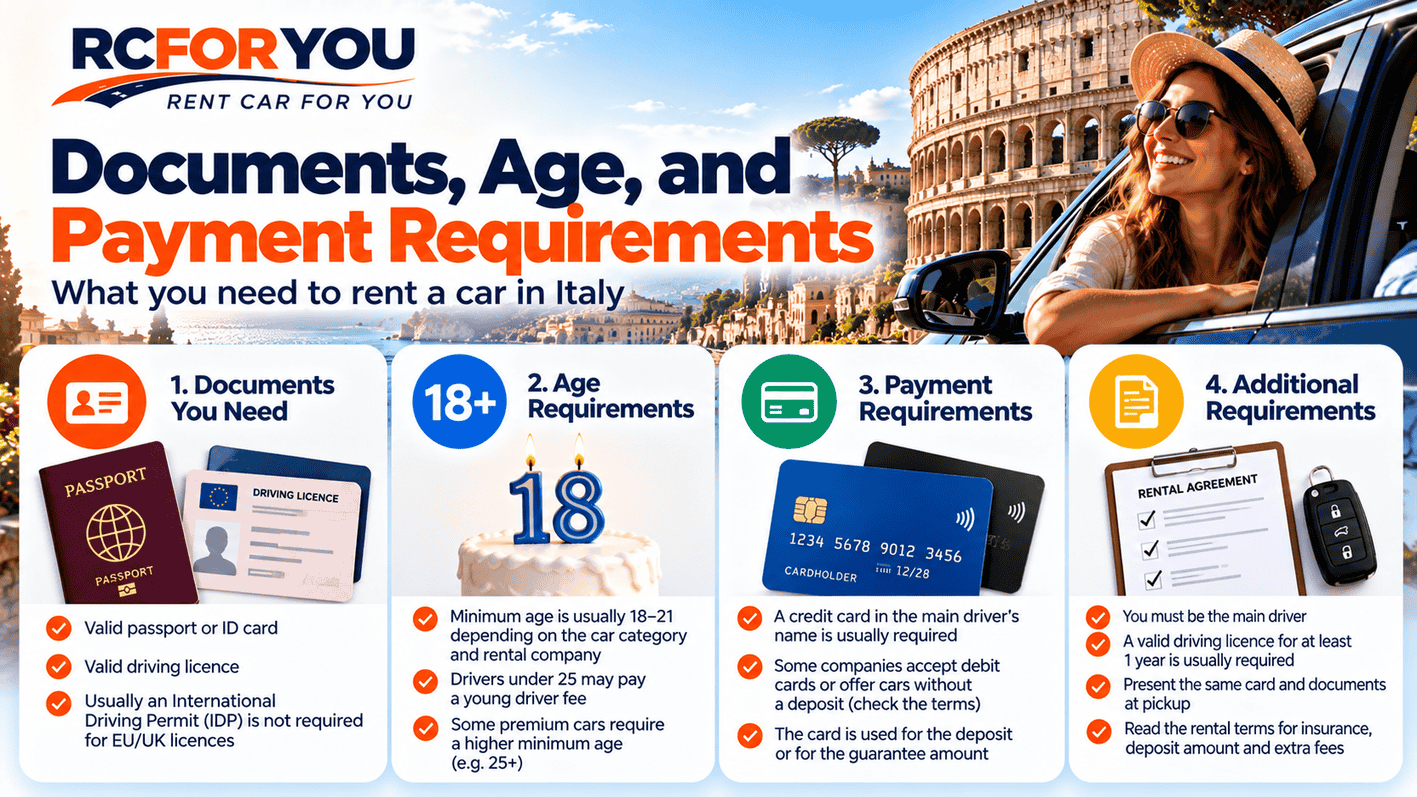
Requirements vary by rental company and vehicle category, but most travellers should prepare:
- A valid passport or official ID.
- A valid driving licence.
- A rental voucher or booking confirmation.
- A payment method accepted by the supplier.
- A physical bank card in the main driver’s name, if required.
- An International Driving Permit or official translation where required.
- Any documents requested for additional drivers.
The important point is that an International Driving Permit does not replace your original licence. It is used alongside the original document. Requirements can depend on where your licence was issued, whether it uses the Latin alphabet, the duration of your stay, and the policy of the rental supplier.
Travellers with EU or EEA driving licences can generally use them for a tourist visit. Drivers with licences issued outside the EU/EEA may need an International Driving Permit or an official Italian translation, depending on the applicable rules and the rental company’s terms. Confirm the documentation requirement before you travel—do not wait until you reach the rental desk.
Age and driving-experience requirements also vary. Economy cars may have more flexible conditions, while premium vehicles, large SUVs, vans, or luxury models can require a higher minimum age, more years of licence history, and a stricter payment-card policy.
Deposit, Card Hold, and Insurance Excess
These three terms are often confused, but they describe different things.
Security deposit
A security deposit is a refundable amount used as a guarantee during the rental. Depending on the supplier and tariff, the company may block the money on a bank card or charge it and refund it after the car is returned according to the agreement.
Card pre-authorisation
A pre-authorisation, often called a card hold, is a temporary amount blocked on your card. It may not appear as a completed purchase, but it can reduce your available card balance until the supplier releases it.
Insurance excess
The insurance excess is the amount you may be responsible for if the vehicle is damaged or stolen under the terms of the rental agreement. It is not necessarily the same as the security deposit.
For example, a rental can have a low deposit but a higher insurance excess. Equally, a standard rental may include basic insurance but still require a substantial card hold. The exact conditions must be checked in the offer details.
Full cover or excess reduction
Additional insurance may reduce or remove part of the excess, but it may still include exclusions. Tyres, wheels, glass, underbody damage, interior damage, lost keys, incorrect fuel, and towing may be treated differently depending on the policy.
Read the insurance section before paying. Basic third-party liability cover is generally required for vehicles in Italy, while CDW and theft protection commonly appear in rental packages—but coverage, exclusions, and excess amounts depend on the supplier and selected rate.
Can You Rent a Car Without a Deposit or Credit Card?
It can be possible to find a car rental in Italy without a deposit, with a low deposit, or with a debit card—but these conditions are not available for every vehicle or supplier.
No-deposit and no-credit-card options tend to depend on:
- Pickup city or airport.
- Travel dates and vehicle availability.
- Car category.
- Supplier policy.
- Insurance package.
- Payment method.
- The driver’s age and licence history.
A standard rental may require a physical credit card in the main driver’s name for a security hold. Some selected offers may accept a debit card, online payment, or a smaller deposit, but you should never assume this applies automatically.
Use this process before booking:
- Enter the exact pickup and return dates.
- Select the correct location, such as Rome, Pisa, Catania, or Milan.
- Use filters such as No Deposit, Low Deposit, No Credit Card, or Debit Card Accepted if they are available.
- Open the terms for every individual vehicle—not just the headline price.
- Check whether the supplier requires a physical card at pickup.
- Confirm whether any deposit, card hold, or pre-authorisation will apply.
- Review the insurance excess, fuel policy, mileage allowance, cancellation policy, and late-return fees.
- If an essential point is unclear, ask for written confirmation before paying.
Some Italian rental offers do accept debit cards or provide more flexible payment terms, but accepted cards and deposit rules remain supplier-specific. The physical card requirement can be particularly important: prepaid, virtual, anonymous, or cards not held by the main driver may be rejected.
How to Choose the Right Car
The best vehicle depends on your route, group size, luggage, driving confidence, and parking plans.
Small cars
Small cars are often ideal for couples, city outskirts, narrow roads, and historic towns. They are easier to park and may reduce stress on tight streets.
The compromise is luggage space. If you have several large suitcases, check the stated boot capacity rather than relying on the car’s appearance in photos.
Compact cars and sedans
Compact cars provide a practical balance for two to four travellers. They are usually comfortable enough for longer drives while remaining manageable in towns and car parks.
A sedan may suit a family road trip, but confirm luggage capacity if everyone is travelling with large bags.
Estates, crossovers, and SUVs
An estate, crossover, or SUV can be more comfortable for families, longer routes, and larger luggage loads. They may also offer a higher seating position and more interior space.
However, larger vehicles can be less convenient in historic centres, tight parking spaces, and narrow rural streets. A bigger car is not always better.
Manual or automatic?
Manual cars are common in Italy and can sometimes be lower-priced. However, an automatic may be the better option if you are not confident with hill starts, traffic, winding roads, or driving on unfamiliar routes.
Choose the transmission you genuinely feel comfortable driving. Saving money on a manual car is not worthwhile if it makes the trip stressful.
Insurance and Costs to Check
The daily rental price is only one part of the total cost. Before confirming an offer, check:
- Security deposit or card hold.
- Insurance excess.
- Included insurance and exclusions.
- Tyres, wheels, glass, mirrors, underbody, interior, and key cover.
- Fuel policy.
- Mileage allowance and extra-kilometre charges.
- Additional driver costs.
- Child seats, GPS, Wi-Fi devices, or other extras.
- Out-of-hours pickup or return fees.
- One-way rental costs.
- Toll-road charges.
- Parking costs.
- ZTL and traffic-fine administration fees.
- Cancellation and modification rules.
A full-to-full fuel policy is usually the easiest to understand: you collect the car with a full tank and return it with the same level. Take a photo of the fuel gauge and odometer at both pickup and return.
For longer routes, check whether mileage is unlimited or capped. A low daily rate can become less attractive if the rental includes a strict mileage limit, expensive insurance add-ons, or a substantial card hold.
Driving in Italy
Italy drives on the right. On multi-lane roads, use the right lane for normal driving and move left primarily to overtake before returning to the right.
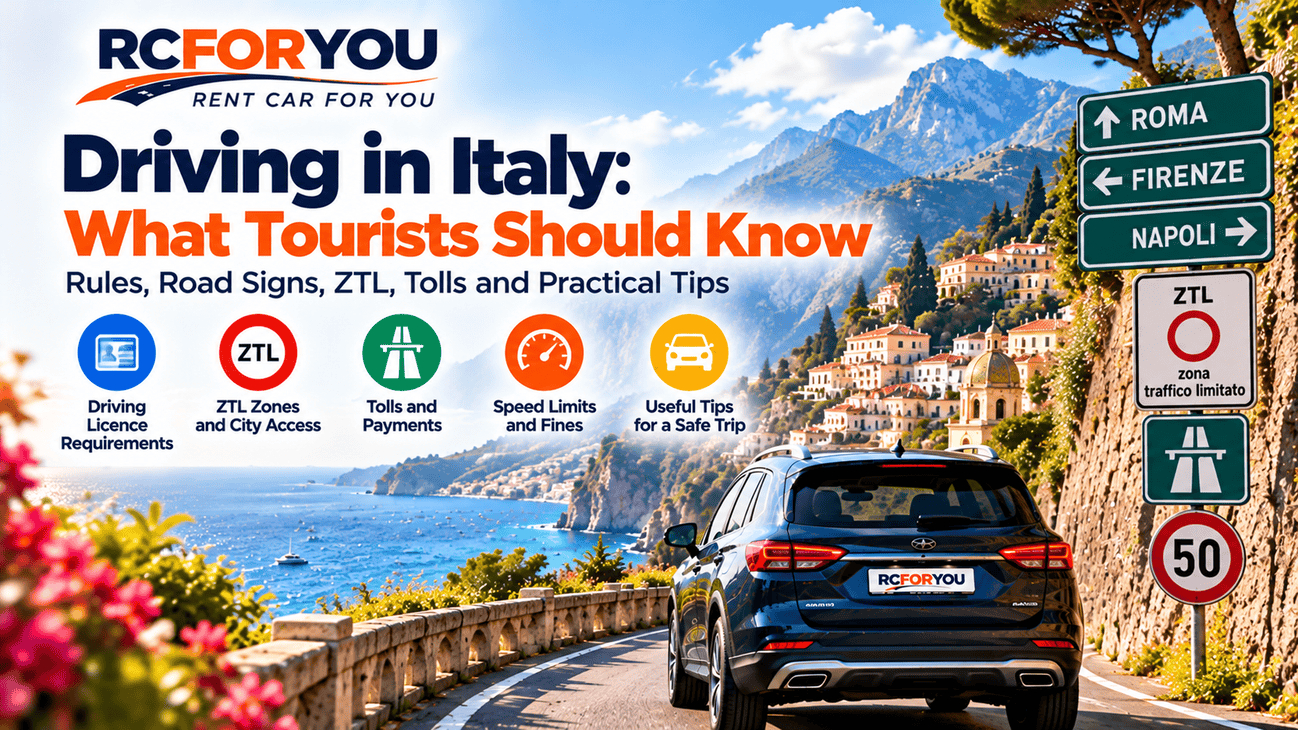
Italy has motorways known as autostrade, which are generally toll roads, and other main and secondary roads that may have different limits and facilities. The exact speed limit depends on the road type, weather, signs, and local conditions.
Typical maximum limits are often:
- 50 km/h in built-up areas.
- 90 km/h on secondary rural roads.
- 110 km/h on main extra-urban roads.
- 130 km/h on the autostrada in dry conditions.
Lower limits can apply in rain, snow, roadworks, tunnels, urban areas, and other local conditions. Always follow posted signs, rather than relying only on general limits or navigation apps.
Most motorway routes involve tolls. At toll gates, lanes may accept cash, cards, or electronic payment systems. Check lane signage before entering, especially if you need a staffed lane or a payment method that requires a PIN. Italian motorways commonly charge by distance travelled.
Plan your parking before driving into a busy centre. Parking is limited in many tourist areas, and the colour of road markings may indicate different parking rules. Read the local signs rather than assuming every marked space works the same way in every town.
What Is a ZTL?
ZTL stands for Zona a Traffico Limitato, meaning Limited Traffic Zone. These restricted areas are common in historic city centres and are designed to limit traffic, protect heritage areas, and manage pollution.
A ZTL may operate all day, at set hours, on certain days, or only for specific vehicle types. Entry points are often monitored by cameras that record number plates. If you enter without permission, you may not be stopped immediately—the charge can be processed later through the rental company.
ZTL rules are particularly important in cities such as Rome, Pisa, Catania, and Milan, as well as many smaller historic towns.
To reduce the risk of a problem:
- Check local ZTL rules before driving into a city centre.
- Do not rely only on GPS; some navigation tools may route you through restricted streets.
- Look carefully for ZTL signs, access times, and camera-controlled gates.
- Use a car park outside the restricted area where possible.
- Continue by metro, bus, tram, taxi, or on foot.
- If your hotel is inside a restricted zone, contact it in advance and ask whether it can register your licence plate or provide an authorised arrival route.
Never assume that following local traffic means you are permitted to enter. Residents, taxis, delivery vehicles, buses, and authorised guests may have access that a rental car does not.
Safe Pickup Checklist
Before leaving the rental location, take a few minutes to protect yourself from avoidable disputes:
- Confirm the vehicle category, pickup and return locations, dates, and times.
- Read the agreement before signing it.
- Check the security deposit, card hold, payment method, and insurance excess.
- Inspect the bodywork, wheels, tyres, glass, mirrors, interior, fuel level, and odometer.
- Take clear photos and a short video of the vehicle before driving away.
- Ensure that every existing scratch, dent, chip, or issue is listed in the handover report.
- Test headlights, indicators, wipers, air conditioning, and dashboard warning lights.
- Save the rental company’s contact number and roadside-assistance details.
- Ask about fuel rules, tolls, ZTL restrictions, and late-return charges.
- At return, take fresh photos, request the return confirmation, and keep all documents.
Common Mistakes to Avoid
- Booking only by the lowest advertised daily price.
- Assuming a no-deposit option means there is no insurance excess.
- Not checking whether a debit card is accepted.
- Arriving without the physical card required by the supplier.
- Choosing a car too small for your group and luggage.
- Driving into a ZTL without confirmed authorisation.
- Ignoring parking signs or assuming all parking bays follow the same rules.
- Failing to document existing damage before departure.
- Returning the car late or with less fuel than required.
- Driving into city centres when parking outside and using public transport would be simpler.
Frequently Asked Questions
Can I rent a car in Italy without a deposit?
Sometimes. Selected offers may provide no-deposit or low-deposit conditions, but availability depends on the supplier, location, dates, vehicle class, insurance package, and payment method. Always read the conditions for the specific car.
Can I rent a car in Italy with a debit card?
Some suppliers accept debit cards, but others require a credit card for a security hold. Confirm the card type, whether it must be physical, and whether it must be in the main driver’s name before booking.
Do I need a credit card?
Not always, but many standard rental tariffs still require one. If you do not have a credit card, search specifically for debit-card, no-credit-card, or no-deposit options and verify the conditions directly in the rental terms.
Do I need an International Driving Permit?
It depends on where your licence was issued, the language on the licence, applicable rules, and the supplier’s policy. EU/EEA licences are generally straightforward for tourist travel, while drivers from outside the EU/EEA may need an IDP or official translation alongside their original licence.
What is the difference between a deposit and insurance excess?
A deposit or card hold is a temporary financial guarantee. Insurance excess is the amount you may be responsible for if covered damage or theft occurs. They are separate conditions, although they may be related in the rental agreement.
Is it difficult to drive in Rome, Pisa, Catania, or Milan?
It depends on your driving experience and route. The biggest challenges are usually parking, traffic, one-way streets, narrow roads, and restricted zones—not long-distance motorway driving. Collecting the car outside the centre and planning parking in advance can make the experience easier.
What is a ZTL in Italy?
A ZTL is a Limited Traffic Zone with restricted vehicle access. It is often camera-controlled and may apply only at certain times. Check local signs and rules before entering.
Is a small car better in Italy?
For many travellers, yes. A compact car is easier to park and navigate through narrow streets. However, choose a larger category if you need sufficient room for passengers, child seats, or large luggage.
Final Thoughts
The best car rental in Italy is not necessarily the one with the lowest daily price. Choose an offer with clear deposit terms, an accepted payment method, suitable insurance, a car category that fits your journey, and transparent pickup and return rules.
Before you pay, compare the total cost—not just the headline rate. Before you drive, inspect the car and document its condition. And before you enter a historic centre, check ZTL rules and parking options. With those steps in place, renting a car can be one of the easiest ways to see much more of Italy at your own pace.