Google Veo 3: генерация видео, инструкция к ИИ и 15 небанальных промптов
Google Veo 3 — одна из самых продвинутых нейросетей для генерации видео: она умеет создавать ролики по текстовому описанию, работать с исходными кадрами и референсами, а также генерировать звук вместе с изображением. Но качество результата здесь сильно зависит не только от самой модели. Один и тот же сюжет можно получить как убедительную сцену с нормальной физикой и операторской работой или как типичный «нейросетевой» ролик — разница часто начинается с того, как сформулирован запрос.
В этом материале разберем, как пользоваться Veo 3 именно с практической точки зрения: как строить промпты, задавать движение камеры, свет, действия персонажей и звук, когда нужны референсы и почему некоторые инструкции модель выполняет хуже других. В конце — 15 готовых примеров для генерации видео с необычными сюжетами, которые можно использовать как есть или адаптировать под свои задачи.
Примеры ниже построены вокруг конкретных действий, материалов, физики и звука — то есть тех деталей, которые действительно помогают показать возможности Google Veo 3.
Что такое Google Veo 3 и что умеет нейросеть
Veo 3 — семейство видеомоделей Google DeepMind, предназначенное для генерации коротких видеосцен с управлением композицией, движением камеры, персонажами, окружением и звуком. В актуальном Google Flow используются модели поколения Veo 3.1, однако запрос «Veo 3» по-прежнему остается общим названием всей этой линейки.
Главное отличие Veo от ранних генераторов видео — модель можно использовать не только для простого text-to-video. В зависимости от выбранной версии и режима Flow доступны генерация из текста, анимация первого кадра, переход между первым и последним кадром, работа с референсами и продолжение уже созданных сцен. Поддерживаемый набор функций отличается между Veo 3.1 Lite, Fast и Quality.
Особенно важна работа со звуком. В промпте можно отдельно описать фоновую атмосферу, шумы объектов, голос и реплики персонажей. Google рекомендует задавать вместе со сценой не только действие, но и тип кадра, движение камеры, стиль, свет, внешность персонажей, локацию и аудио — чем конкретнее эти элементы описаны, тем больше контроля над результатом.
- Текст в видео. Описываете сцену с нуля: героя, действие, окружение, камеру, свет и звук.
- Первый кадр в видео. Загруженное изображение становится исходной сценой, а в промпте нужно в первую очередь описать дальнейшее движение.
- Первый и последний кадр. Модель строит переход между двумя заданными состояниями сцены.
- Референсы. В поддерживаемых режимах можно использовать изображения персонажей и объектов, чтобы лучше контролировать их внешний вид.
- Нативный звук. Veo может создавать окружающий шум, звуковые эффекты и речь вместе с видеорядом.
При этом Veo 3 не стоит воспринимать как кнопку «сделать красиво». Модель лучше работает, когда запрос похож на короткое режиссерское задание: понятно, что находится в кадре, что именно происходит за несколько секунд, как движется камера и какие детали должны привлечь внимание зрителя.
Сгенерировать видео в Veo 3 из России
Как правильно написать промпт для Veo 3
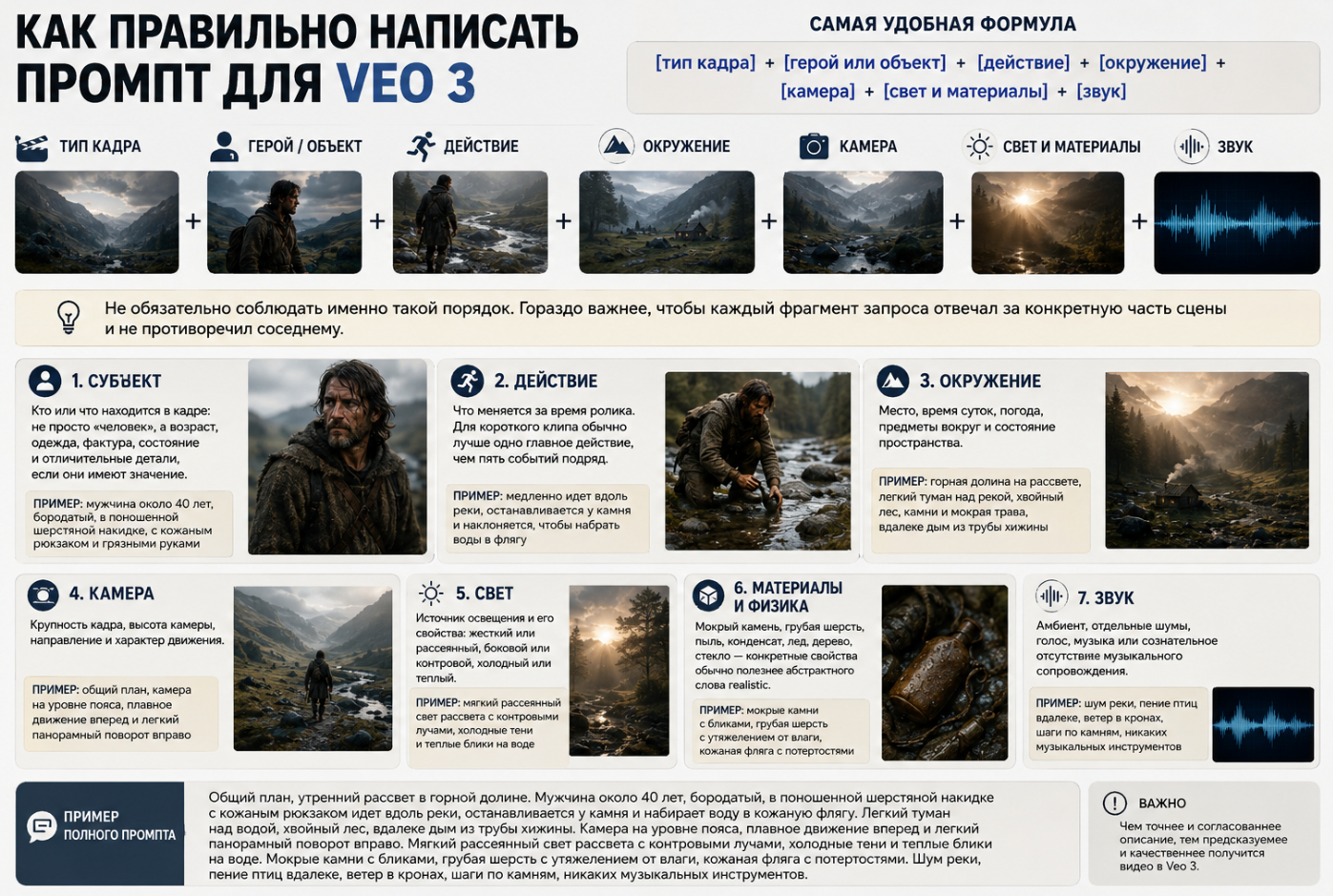
Самая удобная формула выглядит так:
[тип кадра] + [герой или объект] + [действие] + [окружение] + [камера] + [свет и материалы] + [звук]
Не обязательно соблюдать именно такой порядок. Гораздо важнее, чтобы каждый фрагмент запроса отвечал за конкретную часть сцены и не противоречил соседнему.
- Субъект. Кто или что находится в кадре: не просто «человек», а возраст, одежда, фактура, состояние и отличительные детали, если они имеют значение.
- Действие. Что меняется за время ролика. Для короткого клипа обычно лучше одно главное действие, чем пять событий подряд.
- Окружение. Место, время суток, погода, предметы вокруг и состояние пространства.
- Камера. Крупность кадра, высота камеры, направление и характер движения.
- Свет. Источник освещения и его свойства: жесткий или рассеянный, боковой или контровой, холодный или теплый.
- Материалы и физика. Мокрый камень, грубая шерсть, пыль, конденсат, лед, дерево, стекло — конкретные свойства обычно полезнее абстрактного слова realistic.
- Звук. Амбиент, отдельные шумы, голос, музыка или сознательное отсутствие музыкального сопровождения.
Камера в промптах Veo 3: полезные формулировки
Не стоит превращать каждый промпт в перечень операторских терминов. Обычно достаточно одного движения камеры или приема, который подходит конкретной сцене:
- locked-off static shot — полностью неподвижная камера. Подходит для атмосферных сцен, архитектуры и кадров, где движение происходит внутри композиции.
- slow push-in — камера медленно приближается к объекту или персонажу. Хорошо работает для создания напряжения, ожидания и постепенного раскрытия важной детали.
- side tracking shot — камера движется параллельно объекту. Удобный прием для съемки идущего человека, транспорта, животных и различных процессов в движении.
- rack focus — плавный перевод фокуса с одного объекта на другой. Помогает переключить внимание зрителя между передним и задним планом без движения самой камеры.
- handheld documentary camera — легкие естественные движения ручной камеры. Используйте для документального реализма, репортажных сцен и эффекта присутствия.
- extreme macro shot — экстремально крупный план. Подходит для съемки фактуры материалов, насекомых, кристаллов, небольших механизмов и биологических структур.
Не пытайтесь уместить в один короткий ролик сразу несколько сложных приемов. Конструкции вроде crane shot + orbit + dolly zoom + handheld camera дают модели противоречивые инструкции. Лучше выбрать одно основное движение камеры, а внимание зрителя направлять композицией, фокусом и действиями внутри кадра.
Как задавать звук и реплики
Одна из сильных сторон Veo 3 — возможность описывать звук прямо вместе со сценой. Лучше отделять звуковую режиссуру от визуальной части отдельным предложением или блоком Audio:.
Ambience отвечает за фон: ветер, вентиляция, город за окном, дождь по крыше, гул толпы.
Foley — конкретные звуки действия: скрип кожи, удар инструмента, шаги по гравию, треск льда, шелест бумаги.
Dialogue нужен, когда персонаж действительно должен что-то сказать. Реплику лучше писать дословно и не перегружать кадр длинным монологом.
Music стоит добавлять только тогда, когда она нужна сюжету. Фраза No music иногда полезнее очередного «cinematic orchestral soundtrack»: натуральный звук способен сделать сцену убедительнее.
Почему 8K, 12K и masterpiece не делают видео лучше
В промптах для генераторов изображений давно закрепилась привычка дописывать в конец 8K, ultra detailed, masterpiece, award-winning. Для Veo такой подход мало что дает.
Разрешение итогового ролика определяется моделью и настройками сервиса. А такие формулировки, как museum-quality cinematography или Unreal Engine 5 quality, слишком расплывчаты и иногда даже конфликтуют с запросом на реалистичную съемку.
Вместо hyper realistic 12K masterpiece полезнее написать:
natural skin texture, restrained contrast, slightly imperfect handheld camera movement, soft overcast daylight, realistic cloth physics
Здесь каждая характеристика описывает что-то, что действительно можно увидеть в кадре.
15 промптов для Veo 3 с небанальными сюжетами
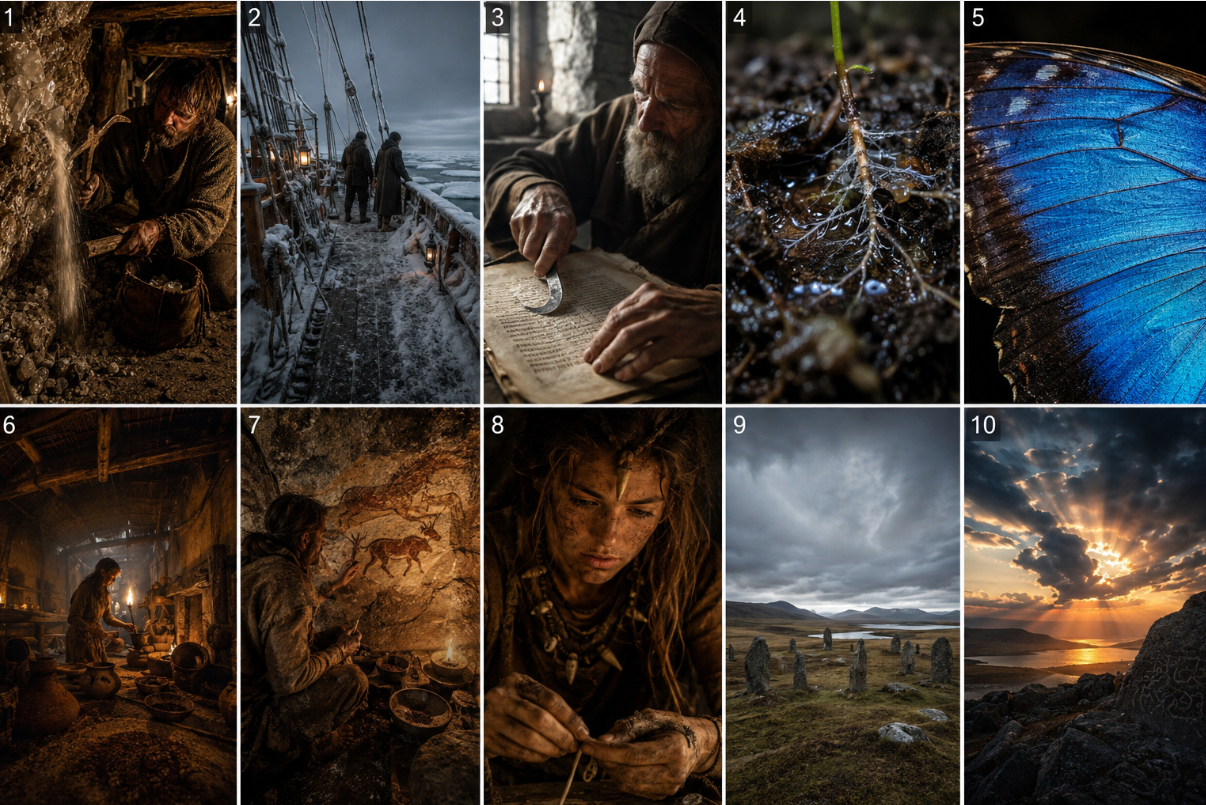
1. Шахтер бронзового века в соляной выработке
Сюжет: камера оказывается внутри узкой древней шахты. Рабочий добывает кристаллы соли примитивными инструментами, а основное напряжение создают теснота, слабый огонь лампы и потрескивающие деревянные крепления.
Historical documentary, a single continuous shot inside a narrow Bronze Age alpine salt mine. A tired miner in a rough woven wool tunic kneels beside a timber-braced shaft and loosens translucent halite crystals with an antler pick and a wooden wedge, placing the fragments into a stitched leather pouch. Begin with a close macro view of salt dust falling from the rock, then slowly pull back to reveal the cramped tunnel and the miner's dirt-covered hands. Damp timber, coarse wool, scratched leather and mineral surfaces should feel physically tangible. A small tallow lamp creates unstable warm light against the cold darkness. No heroic posing, no modern objects. Audio: quiet tapping against salt, leather creaking, water dripping somewhere deeper in the mine, controlled breathing and an occasional low groan from the timber supports. No music.
2. «Белжика» во льдах Антарктики, 1898 год
Сюжет: вместо привычного кораблекрушения — момент ожидания. Судно зажато льдом, люди почти ничего не делают и прислушиваются к тому, как лед медленно давит на деревянный корпус.
1898 Antarctic expedition documentary. A low tracking shot moves slowly along the frost-covered wooden deck of the Belgica while the ship remains trapped inside dense pack ice. Frozen ropes hang rigid from the rigging. Two exhausted crew members in heavy period wool clothing stand silently near the rail, listening to pressure building beneath the hull. Fine wind-driven snow crosses the deck horizontally. The sky is flat graphite grey with no dramatic sunset or aurora. Oil lamps provide a few weak pockets of amber light. Natural historical textures, restrained colors, weathered wood, ice crust and frozen fabric. Audio: deep irregular cracks traveling through the pack ice, wooden hull timbers creaking under pressure, rigging humming in the wind, loose canvas snapping occasionally. No music and no dialogue.
3. Повторное использование пергамента в средневековом скриптории
Сюжет: монах не пишет красивую золотую букву, а готовит старый лист к повторному использованию — осторожно снимает прежние чернила, под которыми остается едва заметный «призрак» старого текста.
Intimate historical realism inside a late-medieval stone scriptorium. Over-the-shoulder close shot of an elderly scribe carefully scraping faded writing from a reused vellum sheet with a small crescent-shaped knife. Fine parchment fibers lift from the surface and ghost traces of the previous text remain visible beneath the cleaned area. The camera holds steady, then performs a slow rack focus from the scribe's cracked fingertips to the erased lettering. Cold diffuse daylight enters through a narrow unglazed window while a small candle adds a weak warm edge to the hands. No polished fantasy aesthetic. Audio: delicate scraping of blade against parchment, distant quill scratching from another desk, cloth shifting, occasional wind passing through the stone window. No music.
4. Мицелий после первого дождя
Сюжет: научная макросъемка показывает не фантастическую светящуюся сеть, а более правдоподобный процесс: вода проходит через почву, а тонкие грибные гифы постепенно осваивают пространство вокруг корня растения.
Scientific macro time-lapse showing a cutaway section of dark forest soil immediately after rainfall. Fine fungal hyphae gradually extend through narrow pores between soil particles and wrap around the microscopic root hairs of a young plant. Tiny beads of water travel through the soil by capillary action, temporarily darkening individual grains as they pass. Small pieces of organic matter shift slightly as moisture enters the structure. No artificial bioluminescence and no science-fiction glow. Extremely shallow depth of field, soft directional light from above, realistic brown, charcoal and muted green tones, natural documentary microscopy aesthetic. Audio: distant rain filtered through layers of soil, occasional tiny grains shifting, a very restrained low natural ambience. No musical score.
5. Почему крыло Morpho меняет цвет
Сюжет: камера проходит почти вплотную над крылом бабочки. По мере изменения угла зрения одни и те же микроскопические чешуйки меняют оттенок от темно-синего до яркого голубого без какой-либо магии или свечения.
Extreme macro documentary shot moving slowly across the microscopic scales of a Morpho butterfly wing. At first the surface appears deep cobalt blue. As the viewing angle changes, the overlapping ridged scales shift naturally toward brilliant cyan and muted violet because of structural coloration. Individual scales resemble thousands of tiny layered shingles, with occasional imperfections and missing scales visible between them. The camera movement is extremely slow and precise, with a narrow plane of focus moving across the surface. Soft controlled laboratory illumination, neutral dark background, realistic optical behavior, no artificial glow and no fantasy particles. Audio: almost silent laboratory room tone, a faint ventilation hum and an extremely subtle natural rustle as the wing moves. No music.
6. Сублимация инея в сухом горном воздухе
Сюжет: макро-таймлапс показывает кристаллы инея на черном металлическом корпусе прибора высокогорной обсерватории. После восхода они постепенно уменьшаются, причем на поверхности не образуются капли воды.
Locked extreme macro time-lapse of delicate hoarfrost crystals covering black anodized aluminum equipment outside a high-altitude observatory before sunrise. The surrounding air remains extremely dry and below freezing. As the first sunlight begins to warm the dark metal, individual frost branches slowly shrink and retreat directly from their outer tips. Their complex crystalline geometry becomes simpler minute by minute, leaving clean dry metal behind with no visible liquid droplets. Low grazing sunlight catches the crystal edges while the background remains almost black. Scientifically restrained, natural optical detail, no dramatic steam or magical effects. Audio: thin mountain wind, a distant mechanical hum from observatory equipment and occasional quiet metal contraction sounds. No music.
7. Ночная смена маленького портного
Сюжет: миниатюрная моль из войлока занимается неожиданным делом — чинит дырку в шерстяном пальто. Закончив последний стежок, она замечает рядом еще одну дыру и молча катит к ней катушку.
Handcrafted stop-motion scene inside an old tailor's drawer. A tiny moth made from grey felt and stitched fabric is repairing a hole in a heavy charcoal wool coat instead of eating it. The moth pulls a long red thread through the final stitch with visible effort, tightens the repair, then pauses proudly. A slight camera pan reveals another small tear farther along the coat. The moth lowers its head, grabs the wooden spool and begins dragging it toward the new hole. Visible fibers, imperfect hand stitching, miniature wooden tools and subtle stop-motion frame variation. Warm work-lamp lighting with deep soft shadows. Audio: thread sliding through wool, a needle tapping against a metal thimble, wooden spool rolling over the drawer, soft fabric rustle. No dialogue, only a tiny exhausted sigh at the end.
8. Рабочий сцены и картонная луна
Сюжет: короткометражная история происходит не на сцене, а за кулисами. Маленький рабочий из старых театральных билетов поднимает картонную луну, трос срывается, и ему приходится поймать декорацию за секунду до выхода актеров.
Tactile paper-and-fabric stop-motion animation backstage in a miniature old theatre. A tiny stagehand constructed from folded ticket stubs operates a hand-cranked pulley that slowly raises a painted cardboard moon above the unseen stage. The cotton string suddenly slips from the wooden wheel. The moon drops several centimeters and the stagehand catches the line with both hands, sliding across the dusty floor before managing to secure it around a brass hook. The camera tracks gently along the miniature rigging without showing the audience. Handmade cardboard edges, frayed rope, chipped paint, faded velvet curtains and warm tungsten work lights. Audio: muffled orchestra playing beyond the curtain, pulley squeaks, rope fibers tightening, quick paper footsteps and the distant hush of an audience waiting for the scene to begin.
9. Горгулья и слишком смелый голубь
Сюжет: старая каменная горгулья пытается сохранить грозный вид перед голубем, который совершенно ее не боится. В итоге птица устраивает гнездо прямо между каменными рогами.
Stylized tactile 3D animation at dawn on the ledge of an old gothic cathedral. A weathered stone gargoyle notices a stubborn city pigeon walking directly toward it. The gargoyle slowly leans forward and opens its heavy stone jaw in an exaggerated attempt to look terrifying. The pigeon pauses, looks at the gargoyle, then calmly hops closer and places a small twig between its stone horns. The gargoyle freezes in disbelief while another twig arrives. Avoid glossy cartoon surfaces: the granite should be porous, chipped and damp, with tiny moss growth inside cracks. Soft grey morning sky and restrained natural lighting. Audio: distant waking city ambience, pigeon footsteps on stone, quiet cooing, grinding granite as the gargoyle moves and several tiny pebbles falling to the street below. No music.
10. Аквариум после закрытия
Сюжет: пустой технический коридор большого океанариума ночью. Людей нет, но пространство постоянно меняется из-за воды: тени рыб проходят по стенам, вентиляция шевелит пластиковую завесу, по стеклу ползет конденсат.
Locked-off cinematic shot inside a narrow public aquarium maintenance corridor late at night after closing. One entire wall is formed by the back side of a huge ocean tank, filling the corridor with dim blue-green moving light. A large ray glides slowly past the glass and its shadow travels across pipes, buckets and a wet concrete floor. Condensation forms irregular trails down the viewing panel. A transparent strip curtain at the far end moves slightly in the ventilation airflow. No people enter the frame. Practical industrial details, mildly worn surfaces, natural reflections and restrained documentary composition. Audio: continuous filtration pumps, low ventilation hum, distant water movement, occasional plastic curtain clicks and a faint metallic vibration from the pipework. No music.
11. Гидрофон на глубине
Сюжет: камера медленно приближается к научному гидрофону на морском дне. Вместо очередного затонувшего корабля в кадре обычное оборудование, мимо которого неожиданно проходит длинная светящаяся колония сифонофор.
Deep-ocean documentary shot at roughly 700 meters depth. The camera performs a very slow push toward a scientific hydrophone mooring anchored on a dark silty seabed. Marine snow drifts continuously through the water column. A long, delicate siphonophore gradually enters the edge of frame, its small natural bioluminescent structures appearing one after another as it bends in the current and passes behind the instrument cable. The cable vibrates subtly and a faint sediment cloud lifts near the anchor. No shipwreck, treasure, divers or artificial spotlights. Minimal blue-black palette, physically plausible underwater light falloff and restrained scientific cinematography. Audio: hydrophone perspective with low-frequency ocean pressure noise, a distant whale call, subtle cable resonance and occasional faint clicks from unseen marine life. No music.
12. Первый паром до рассвета
Сюжет: пустой сельский терминал в ледяной дождь. Почти ничего не происходит, пока за туманом постепенно не появляется низкий гул первого утреннего парома и слабые пятна его фар.
Static observational 35mm-style shot of a small rural ferry terminal before dawn during freezing rain. The camera is positioned beneath the edge of an empty passenger shelter, looking across wet asphalt toward a dark stretch of water. Rain strikes the roof and forms uneven reflective streams across the ground. A timetable case, old bench and safety railing remain motionless while thin ice gradually builds along exposed metal edges. Far across the foggy water, two diffuse ferry lights slowly become visible without ever dominating the frame. Natural low-light exposure, muted grey-blue palette, subtle film grain, no dramatic color grading. Audio: freezing rain against corrugated metal, wind passing around the shelter, occasional water dripping from the gutter and a very low ferry engine gradually becoming audible through the fog. No music.
13. Архитектура забывания
Сюжет: вместо привычного рассыпающегося песочного замка память показана как библиотечная карточка. Бумага, пятна и следы времени остаются на месте, а напечатанная информация постепенно исчезает.
Conceptual practical-effects film about memory loss. Extreme close-up of an old wooden library card catalogue. One drawer slowly slides open by itself and reveals hundreds of aged index cards covered with typewritten marks. The camera pushes toward a single card with a worn corner and an old coffee stain. Without the paper changing shape, the dark typed characters begin fading unevenly from the center outward, leaving only shallow impressions in the fibers where the letters used to be. Nearby cards remain untouched. Soft directional window light, restrained beige and charcoal palette, visible dust and paper texture, quiet analogue realism rather than digital glitch effects. Audio: wooden drawer runners, dry paper friction, a distant mechanical clock and faint room tone from an empty archive. No music.
14. Паралич выбора
Сюжет: идея сложного выбора превращается в физический эксперимент. Одна капля жидкости входит в сеть прозрачных каналов, разделяется на десятки потоков и почти полностью останавливается в тупиках.
Minimal conceptual macro film visualizing decision paralysis. Top-down view of a thick frosted-glass plate containing dozens of finely etched branching microchannels. A single dark cobalt-blue droplet enters from one side and begins moving through the transparent network. At each junction it divides into smaller streams, creating more and more simultaneous paths. Most branches gradually slow and stop at sealed dead ends, while only one extremely thin stream continues moving toward an open outlet on the opposite side. Perfectly clean white environment, realistic fluid surface tension and refraction, no labels, icons, arrows or interface graphics. Slow controlled macro camera movement. Audio: nearly silent room tone, subtle glass resonance and delicate liquid movement amplified like a laboratory recording. No music.
15. Логистика без схем и стрелок
Сюжет: абстрактная модель цепочки поставок работает как настольный механический макет. Центральный маршрут неожиданно останавливается, после чего система физических заслонок сама перенаправляет поток по обходным линиям.
Premium practical miniature film representing supply-chain resilience without text or infographics. An isometric tabletop mechanism consists of narrow wooden conveyor tracks under a clear glass cover. Hundreds of small unfinished wooden beads move steadily along several connected routes toward three collection trays. The central conveyor suddenly stops when one brass gear jams. Mechanical spring gates react one after another and redirect the incoming beads through two longer side routes. After a few seconds of congestion, the flow becomes stable again while the broken central line remains motionless. Precise real-world mechanics, warm wood, brushed brass and clear glass, clean editorial composition, no digital interface elements. Audio: quiet electric motors, rhythmic wooden clicks, a brass gear grinding to a stop, spring gates snapping into position and the rhythm of the system gradually returning to normal.
Как адаптировать эти промпты под свое видео
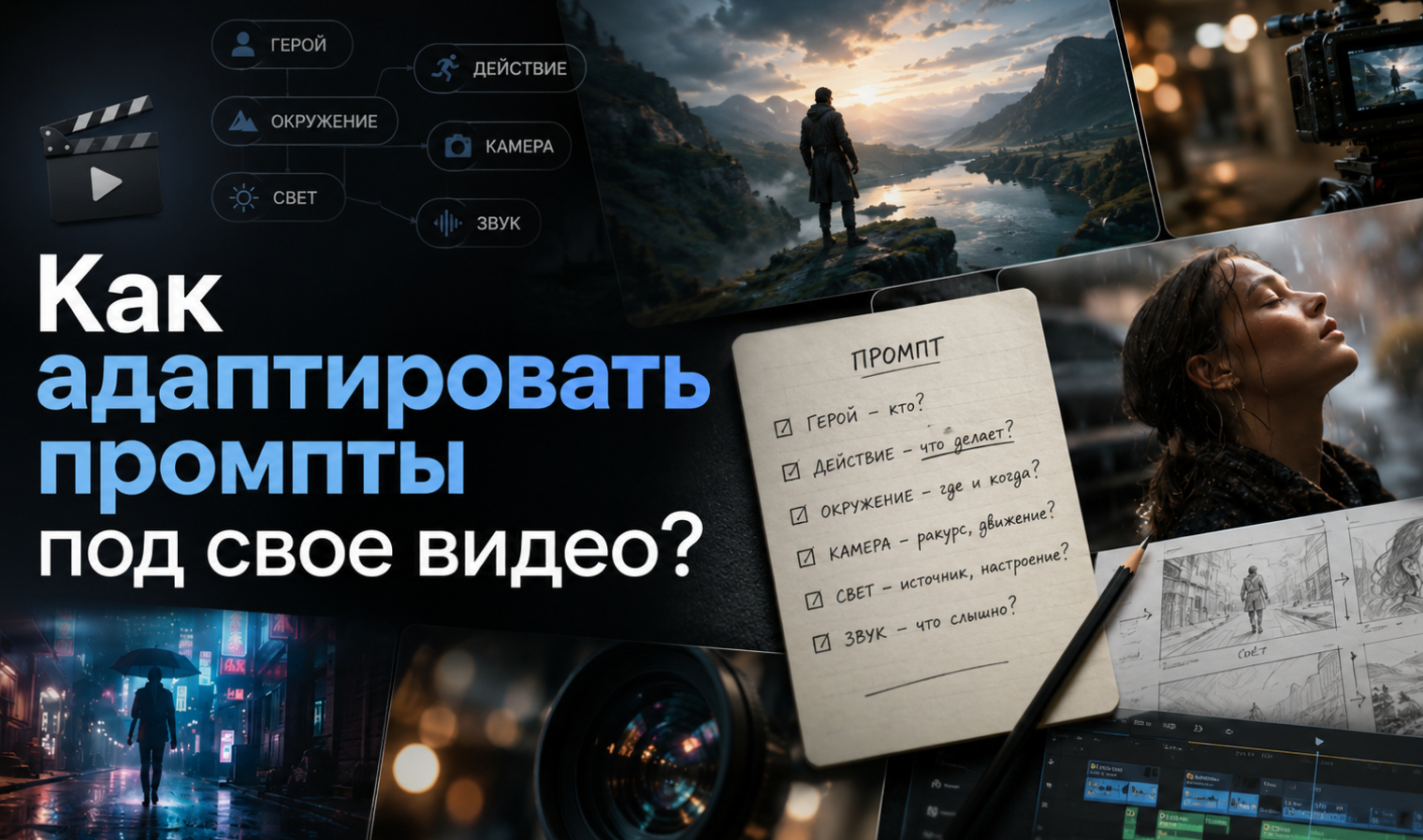
Не копируйте пример целиком, если вам нужен другой сюжет. Проще сохранить его конструкцию. Например, в сцене с шахтой можно заменить историческую эпоху и профессию, но оставить принцип: конкретное действие → один выразительный материал → простое движение камеры → естественный звук.
Если персонаж должен оставаться одинаковым в нескольких сценах, одного текстового описания может быть недостаточно. В режимах Flow, где доступны references или ingredients, лучше использовать референс героя и уже текстом описывать его действие, окружение и операторскую работу.
При генерации из первого кадра не нужно подробно пересказывать модели все, что она уже видит на изображении. Сосредоточьтесь на том, что должно измениться после старта: движение персонажа, камеры, одежды, воды, дыма, света и объектов окружения.
Для перехода между первым и последним кадром описывайте именно промежуточное действие. Если написать две независимые красивые сцены вместо логики перехода, результат чаще выглядит как случайный морфинг.
Негативный промпт и борьба с артефактами
Если генерация идет через Vertex AI, нежелательные элементы можно вынести в отдельный параметр negativePrompt. Например:
subtitles, captions, on-screen text, logos, watermarks, duplicate objects, malformed hands
Главный prompt при этом лучше оставить позитивным и однозначным — описывать то, что должно быть в кадре, а не строить его из десятков запретов.
В интерфейсах без отдельного negative prompt можно оставить одно-два действительно важных ограничения в конце основного запроса, например No subtitles. No on-screen text. Длинная цепочка из двадцати no обычно только усложняет запрос.
Почему Veo 3 не выполняет промпт точно
Слишком много событий. Если герой должен войти в комнату, открыть сейф, найти письмо, прочитать его, испугаться и выбежать наружу, это уже последовательность кадров, а не один короткий shot. Разбейте ее на отдельные генерации.
Противоречивая камера. Одновременно просить неподвижный штатив, handheld shake и круговой облет не имеет смысла. Выберите движение, которое важнее всего.
Абстрактные прилагательные вместо наблюдаемых деталей. Слова epic, stunning, breathtaking, masterpiece почти ничего не объясняют модели. «Мокрый асфальт отражает холодный свет из окна» — объясняет.
Слишком много стилистических референсов. Не смешивайте документальную съемку, пластилиновую анимацию, голливудский блокбастер и рекламный CGI в одном запросе без сюжетной причины.
Не описан звук. Если звук важен, не оставляйте его на усмотрение модели. Даже короткая строка с окружающими шумами делает задачу точнее.
Промпты для Veo 3 лучше писать на русском или английском?
Для сложных запросов я предпочитаю английский: на нем проще использовать устоявшуюся операторскую терминологию и получать повторяемую структуру. Для Veo в Vertex AI английский также указан как поддерживаемый язык промптов.
При этом реплика персонажа может отличаться по языку от остального описания. Практичная схема выглядит так: вся режиссура написана на английском, а нужная фраза оставлена дословно внутри блока Dialogue:.
Насколько длинным должен быть промпт для Veo 3?
Универсального количества слов нет. Хороший запрос должен быть настолько длинным, насколько это необходимо для сцены. Простому статичному кадру иногда хватает нескольких предложений. Сложному взаимодействию персонажа, камеры и звука требуется больше деталей.
Главный критерий — не длина, а плотность полезных указаний. Если предложение нельзя представить в кадре или услышать в аудиодорожке, стоит проверить, действительно ли оно необходимо.
Итог: хороший промпт похож на съемочный план, а не на заклинание
Veo 3 лучше всего раскрывается, когда запрос описывает конкретную сцену: кто находится в кадре, что происходит, как это снято, какой свет взаимодействует с материалами и что слышит зритель.
Поэтому вместо очередного cinematic masterpiece, ultra detailed, 12K начните с более простого вопроса: что именно должно произойти за эти несколько секунд? Если ответ можно ясно представить как один законченный кадр, половина работы над хорошим промптом уже сделана.